Before trusting an AI visibility dashboard, you should be able to tell what counts as a measurement. BrandPresence's homepage makes part of that activity public: successful AI answer samples, successful or partial monitoring runs, active buyer-question groups, and generated recommendations.
The panel gives prospective users a concrete view of what the product is doing. Each counter has a different unit. Knowing those units helps you judge the scope of the activity without confusing it with customer numbers, market coverage, or business results.
A snapshot of the activity panel
The screenshot accompanying this post shows:
- 885+ AI answers sampled: successful API answer samples from measurement runs.
- 445+ AI platform runs: measurement runs that succeeded or partially succeeded.
- 61 buyer questions tracked: active monitoring groups.
- 410+ recommendations generated: stored recommendation records across sites.
View the captured activity panel, or visit the homepage's live activity panel for the latest available figures.
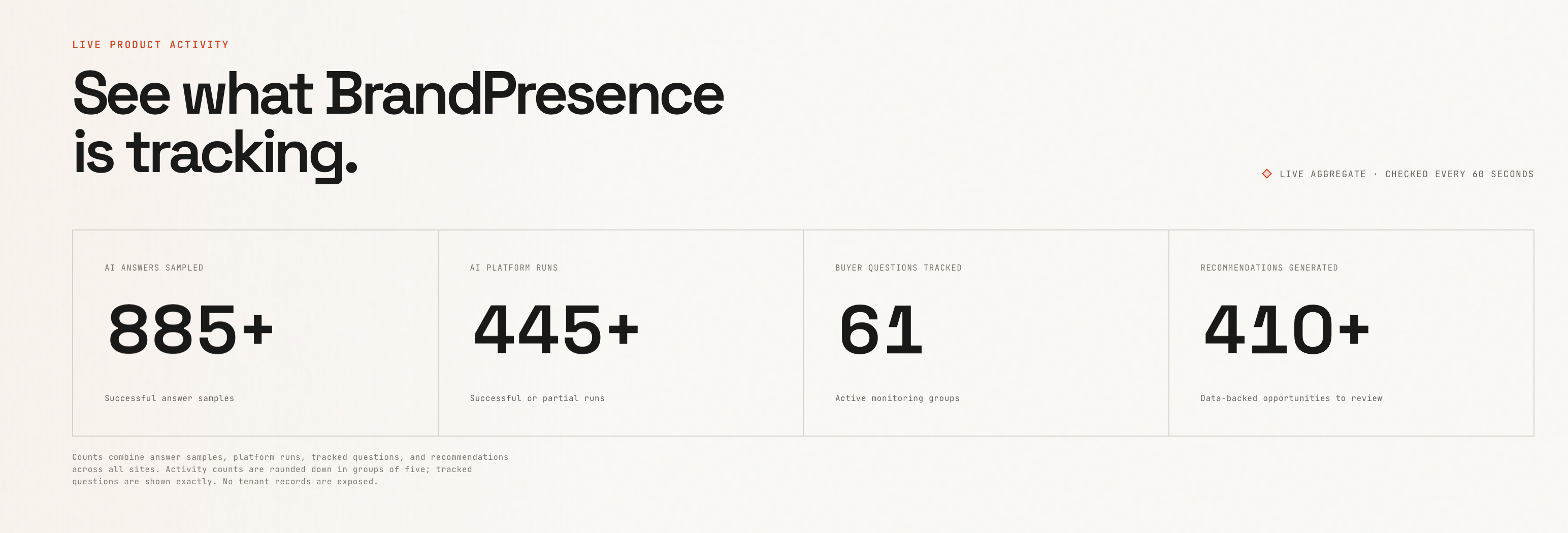
These figures describe the captured panel. The live totals may have changed since the image was taken.
An answer sample is one observation
The first counter includes successful API answer samples attached to measurement runs. Failed samples are excluded.
A sample records an answer under a particular question, provider and measurement configuration. The same question can produce several samples, and a monitoring run can contain more than one. That is why the answer total and run total are different.
This distinction becomes useful when you review your own brand. If one answer mentions you, you have one observation to inspect. If comparable repeated samples keep naming you, you have a recurring pattern to investigate. Neither result shows what every person sees in a consumer chat interface.
BrandPresence measures supported OpenAI, Perplexity and Google Gemini APIs. The provider and measurement surface belong with the answer. An API observation should not be relabeled as a measurement of everyone's ChatGPT, Perplexity or Gemini interface.
A platform run can finish with partial coverage
The run counter includes measurement runs in either a successful or partially successful state. A partially successful run can contain useful retained answers alongside failures.
That matters because a failed request and a missing brand are different outcomes. A successful answer that omits your brand is evidence of an omission in that sample. A request that fails gives you no answer to assess.
The public run total does not expose that detailed coverage. Inside a useful AI visibility audit, you should check successful samples, failed samples and provider coverage before interpreting a rate.
You should also resist dividing the public answer total by the public run total to infer a typical customer's configuration. These totals combine different sites, questions and run settings, and the activity figures are rounded.
Tracked questions means active monitoring groups
The screenshot shows 61 active monitoring groups under the label “Buyer questions tracked.” The number is shown exactly.
A group organizes a tracked question and its measurement history. It can be observed repeatedly or across providers. The count therefore does not mean 61 customers, 61 industries, or 61 unique search queries asked by real buyers.
For your own account, relevance matters more than the size of the question set. A category question such as “Which tools help a small B2B team monitor AI visibility?” tests discovery. “What is BrandPresence?” tests understanding of a named brand. Both can be useful, but they answer different business questions.
The competitor benchmarking guide explains how to keep those question types separate when comparing brands.
Generated recommendations are opportunities to review
The recommendation counter counts stored recommendation records. It is not a count of implemented changes, independent experiments, unique customer problems, or proven improvements.
A useful recommendation should help you decide what deserves attention and let you inspect its supporting evidence. An observed omission may suggest reviewing a relevant product page or a recurring cited source. It does not reveal the provider's internal reason for selecting an answer.
BrandPresence does not turn that recommendation count into an automatic publishing claim. Your site's content stays under your control, and a proposed change remains a hypothesis until you have suitable evidence to assess it.
How the public figures are displayed
The activity panel combines counts across sites and exposes no individual tenant records in its response. The three activity totals are published after reaching 25 records and rounded down in groups of five. The active-question count is exact.
For example, 885+ means the rounded figure is 885; it should not be read as an exact count of 885 or as 885 users.
While the page is visible, the panel checks for an updated aggregate every 60 seconds. Responses can be cached, so this is a periodically refreshed view rather than an event-by-event feed. Figures can also change when the underlying records or active groups change.
What to look for in your own visibility report
The public panel shows product activity. Your own report needs enough detail to support a decision:
- the buyer question and its audience context
- the provider, model and measurement date
- successful samples and failures
- the answer text and returned sources
- separate brand mentions and owned-domain citations
- a clear connection between a finding and the next investigation
Those details let you move from “something was measured” to “I understand what appeared and what deserves attention.”
Start with the free AI visibility snapshot to inspect your brand's starting point, or read how ongoing monitoring works before choosing a cadence.